Showing posts with label East African Food. Show all posts

Tuesday, 4 January 2011

Eating in Tanzania

Tanzania is a place where many cultures have come together.  Over the centuries there have been many Arab traders and Indian settlers who have mixed with the native Africans to create some wonderful foods.  Food really does vary by region, from plain boiled meats and vegetables in Arusha to spicy curries and fish in the coastal regions like Dar es salam. 

Like much of Africa, people in Tanzania often eat their family meals in the communal style.  There are a few rules to follow:

  1. Meals are eaten in the living room on a mattress (mkeka) on the floor.
  2. Small families can share one plate.
  3. Large families are divided, with males, females, and children having different plates. 
  4. Very small children eat with their mothers.  Babies are fed from the communal plate by the mother. 
  5. People eat with their right hands only (because the left hand is used in the toilet).  If you only remember one thing, remember this!  You will have your fellow diners suddenly wash their hands and refuse more food if you breach this rule.
  6. The shared plate will have stew, meat, salad, or fish along with little piles of salt to dip your meat in.  These foods can be eaten by hand or scooped up with chapati, rice or ugali (maize meal).
  7. Meals begin with a bowl of warm water being passed around to clean your right hand.  It often has some lemon juice or a slice of lemon in it.
  8. You can make a small ball of rice or ugali .  Then pinch the ball slightly and use this to scoop up food.


Then place this in your mouth.  It is important to not let your fingers touch your mouth at all.  This can be messy to start with, but with practice gets easier. 

 9.  At the end of the meal everyone washes their hands again.  (For large groups the bowl is quite big). 
10.  Everyone then thanks the mother for the food.  (This really means that you are thanking the father for providing the food as well. )

Ugali


Ugali, fried tilapia, sukumawiki


Ugali is a staple starchy food much like potato or pasta in other cultures.  Ugali is made from maize flour and is used in many parts of Africa.  It is has many names, such as sadza in Zimbabwe.  In some parts of Africa semolina (made from wheat) is used in a similar way.  Ugali is usually prepared with water and is very plain.  It is served with stews or other wet foods.  It is eaten with your hands and can take some practice!  Make a small ball of ugali in your right (always the right!) hand,  flatten it slightly and use this to scoop your stew.

Meals are always served with a bowl of warm water, perhaps with a slice of lemon.  This is passed around to wash your right hand before and after the meal.  I have a friend from Zimbabwe who comes around with a bowl and a pitcher of warm, lemony water which she pours over your hand.  A lovely ritual.


You will need:
fine white maize
water
saucepan
wooden spoon

  1. Fill half of a medium size pan with water and bring to the boil.


2.  Take a few spoonfuls of boiled water and add to 1/4 cup of maize in a bowl.  Mix with additional cold water and stir until the maize is smooth.  .


Add back to the pan and stir almost constantly to prevent lumps on the bottom of the pan.  Boil and stir for a further few minutes until the mixture boils.

3.  Next, add one cup of maize and begin to stir quite vigorously.  It is quite like mashing potatoes.  You are looking to smooth out any lumps quite quickly.  If it is still quite wet you can add another 1/4 cup of maize.  When it is smooth it is ready to be moved to a burner with low heat.  Place a lid on it and leave it for ten minutes.  You can check on it and give it a stir a few times. 


4.  The ugali is then emptied out onto the serving plate.  It is quite firm at this stage, and stands up on its own in a mound. 


Ugali, fried tilapia, and sukumawiki


Traditional "Mwiko" which is a flat wooden spoon used to make ugali.
 

Sunday, 2 January 2011

Sukumawiki

Sukumawiki means "push the week" in Swahili.  It refers to a vegetable dish you have to resort to when there is no money left for meat and all you have is greens from your garden.  Since greens are one of the things I can actually manage to grow successfully in my garden we eat this weekly.  We use any kind of greens, like cabbage, Swiss Chard, and spinach.  We often use frozen spinach in the winter months. 

This makes up part of one of our favourite meals: fish, ugali and sukumawiki.  It is actually my son's favourite meal.  We eat it at least weekly and I am always amazed at how such a picky eater gobbles down spinach and fish!


You will need:

Small onion
Cumin seeds
2 Tomatoes, chopped (optional)
Greens, chopped and washed--leave wet
  1. Slice and fry the onion in a little bit of oil in a large frying pan until quite soft.
  2. Add cumin seeds to toast lightly.
  3. Add tomatoes if using and stir for 2-3 minutes.
  4. Add greens and allow to wilt.  Stir as needed until the greens are all wilted and the ingredients are well mixed.  Add salt and pepper to taste.
  5. Serve on its own or as a side dish to meat, chicken or fish.

Rice and Beans (Wali Maharage)


This is roughly based on East African flavours.  And is flexible enough to be adapted to what you have on hand.  For instance, we almost always have carrots in ours, which would not be traditional.  We eat this once or twice a week.  It is inexpensive, yet full of flavour and protein.  For a heartier meal, this can be served with spicy fried prawns (shrimp) or some grilled meat.  In Tanzania this might be eaten with your hands, but you can use a spoon!

For the Rice:

The rule in our house, according to my Other Half, is that the rice needs to be basmati and preferably Tilda brand.  (I prefer brown rice, but we have to compromise on occasion).  You can actually serve the beans with plain rice of any type if you prefer.  But we always like to spice things up a bit.

  1. Measure out your rice per person and rinse in a sieve or bowl of cold water. 
  2. Boil your kettle.
  3. Toast your spices in a dry saucepan for a few minutes.  Choose any combination of the following: 3-4 cloves, 3-4 cardamon pods, chunk cinnamon bark, some cumin seeds.  We usually stick to two spices. The spices should start smelling nice, but not burn.
  4. Add the rice and boiled water.  Cook rice according to the package instructions. Some people add extra water and sieve later.  Some people follow the package instructions and measure the exact amount of water, which is then absorbed by the rice.   
  5. If you are feeding this rice to children, try to remove the spices from the rice or their portions.  You can warn the adults there are spices in the dish.


For the Beans:

Tin of beans, (any kind, but we love pinto beans), rinsed and drained
small tin of chopped tomatoes, or 2-3 small fresh ones
1/2 tin coconut milk
carrot
sweet/bell pepper
onion
hot chilli (optional--since I don't like chilli, we leave it out and people can add hot sauce afterwards)

You can add other vegetables if you like.  We like mushrooms or green beans in this dish as well when we have them or they need using up!

  1. Chop the onion and fry in a saucepan in a little bit of oil.  When soft, add chopped carrot and pepper, and any other vegetables, including chilli, if using.  Fry for 3-5 minutes to soften the vegetables.
  2. Add the beans and the small tin of tomatoes with their juice and continue to cook over medium heat for ten minutes.
  3. Add about half a tin of coconut milk and simmer for a further 2-3 minutes, stirring constantly, just to heat through.  If you heat the coconut milk too long it will separate.
  4. The vegetables and beans should be both hot and tender.
  5. Serve with rice.
  6. This keeps well for the next day as well. (Cook once, eat twice!)


Monday, 27 December 2010

Bolognese (sort of) and chapati

When my lovely Other Half moved to the UK he learned to love Sunday Roast Dinners and Arsenal football.  But there are some things he just doesn't do.  Like sandwiches.  And pasta.  And so he has invented a new dish for us.  He uses an adaptation of my brother in law's bolognese recipe (the best I have ever had) and some traditional foods from his native Tanzania.  The basic bolognese has two secret ingredients:  Smoked paprika, and fried mushrooms, added just at the end.  I am not sure where my brother in law discovered the recipe, so I cannot credit anyone else.


Following my cook once, eat twice philosophy, we try to make enough to have two meals or more.  The flavours are really nice the next day as well.  And this freezes well.
You will need:

oil
1 onion
1 crushed garlic clove
500 g Mince--beef, turkey, or even cooked lentils
1 tsp smoked paprika
1 tsp Season-all, or to taste
1-2 tsp Mixed dried Italian herbs
2 tins chopped tomatoes (you could use a jar of pasta sauce if you are in a hurry)
2 cups stock or stock cube--to match your meat (beef, chicken, etc)
4-5 mushrooms
3/4 cup peas
chapatis--homemade or store bought

1.  Fry the onion and garlic in a little oil until softened. 
2.  Add mince and stir until browned.
3.  Add spices and herbs and stir for another minute.


4.  Add tomatoes or sauce.
Note:  You could simmer this for 10-20 minutes and then move to step 6 if you are in a hurry.
5.  Add stock and let simmer or place in a low oven or crock pot for 30 -60 minutes.  You can leave this longer.  The longer the better.
6.  Slice and fry the mushrooms.
7.  Place the peas in a large mug with some warm water from the kettle.  Microwave for 1-1.5 minutes.


8.  Before serving add the peas and mushrooms to the meat.


9.  Warm the chapatis either wrapped in foil in the oven or one at a time in a frying pan.  You can warm them dry or with a bit of butter until soft, but not crispy.


The meat is eaten with the chapati, rather than utensils.  You simply rip pieces of the bread and use them to scoop up the sauce.  It does takes practice!

Zege

Zege means "concrete" in Swahili.  But please don't let the name put you off!.  Zege is very popular bar food or as a snack at home. Traditionally it is made by making fresh chips (French fries), but we use oven chips for ease.  Although zege is cosidered a snack, it is very filling.  So concrete refers to both its looks when it comes out of the pan and the filling feeling in your stomach.  We usually eat it for breakfast, lunch or dinner.


Zege

Oven chips---4-5 per person
1-2 eggs per person
salt and pepper
ketchup to serve


1.  Cook the oven chips according to the package directions. 
2.  When ready, put them in a large frying pan with a bit of oil.
3.  Beat eggs, add pepper, and add to the pan.
4.  Cook over a medium heat until the eggs are cooked through, flipping over to ensure they are done.  The zege will brown lightly on each side.
5.  Cut into pieces, split among the plates and serve with ketchup.  Add salt if desired.

Optional:  We sometimes add cooked chicken pieces to the pan along with the eggs.  In Tanzania zege is sometimes served with kebab as well.

Friday, 24 December 2010

Maandazi


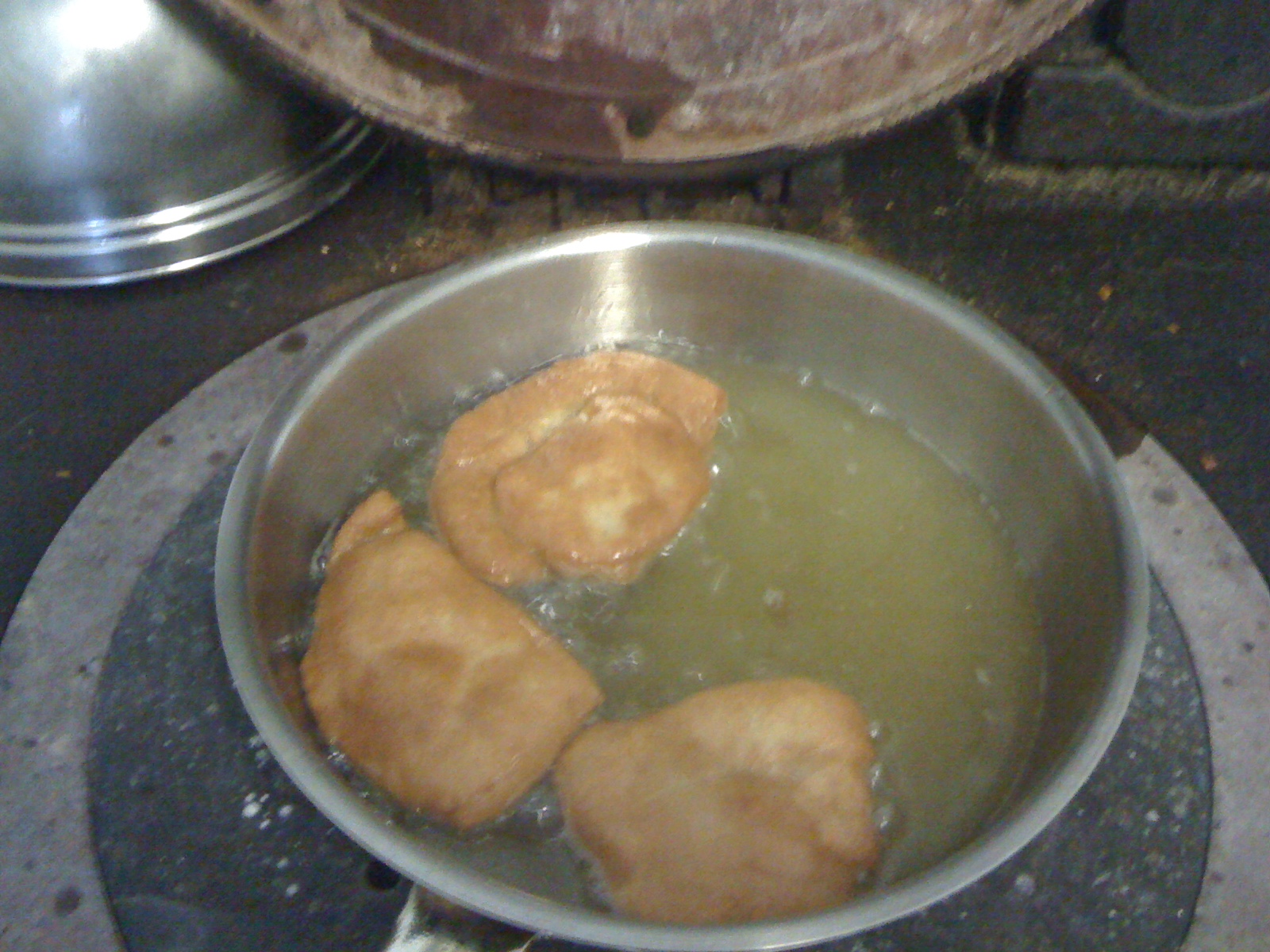
My Swahili dictionary tells me that Maandazi means "confectionary," but they really resemble donuts or Italian zeppole. They are fried balls of dough which are then eaten plain or doused in sugar.

They are sold on the streets in Tanzania every morning.  There are probably as many variations as women in East Africa.  I have heard of coconut versions and you can use a variety of spices or leave them plain.  Some people make the dough with yeast and some are are a more simple egg and flour mix.  I have included two recipes here.

For a time we ate these about once a week, but when I returned to work I found that they were a bit too time consuming to fit in.  We try to have them on special occasions now.  Bring your appetite because they do not keep well.

Maandazi #1

Makes 8

8 oz flour
1 Tablespoon brown sugar
1 teaspoon easy blend yeast
1/4 teaspoon salt
1/2 teaspoon cinnamon or mix of ground cardamom and cinnamon
1 tablespoon vegetable oil
4 oz warm water

oil for frying

By Hand
Mix all dry ingredients well and add wet ingredients until dough forms.  Knead well.  Place in a bowl and let rise for an hour.  Knead out briefly and cut into 8 pieces.  They can be balls, squares or diamonds.  Squash them a bit with your hand.  Let rise again for 30 minutes.  Fry in deep or shallow oil based on your preference. The oil should be hot and bubbling, but not spitting.  They are ready when they are as brown as an onion skin.


Drain on paper towel.  And then, if desired pop into a bag or plastic box with lid with sugar.  Give it a good shake.  I sometimes add some cinnamon to the sugar on special occasions.  Serve warm.  They lose their vitality after a few hours.  Serve with strong coffee or chai (see recipe for chai under Drinks).

By Breadmaker
I actually pop everything in the breadmaker and set it to dough.  Then take out the dough, knead, divide, let rise and fry as above.  The beauty of this is that since you need to let it rise for an hour, you can set the breadmaker to do all of the work while you are still in bed.  Then get up, roll out 8 balls, and let them rise as I make chai and fruit salad.


Maandazi #
This recipe is taken from the book, "Best of Regional African Cooking," by Harva Hachten

Makes 2 dozen

1 cup flour
1 1/4 teaspoons powder
2 tablespoons sugar
pinch of salt
1 egg
1/4 cup water
oil

Sift flour and powder together.  Add sugar and salt.  Stir in egg and water to form dough.  You can add more water if you need to.  Knead dough until smooth and let rise for 30 minutes covered by a towel.  Cut into squares.  Fry in shallow or deep oil until golden brown.  Drain on paper towels.  Sprinkle with sugar if desired.


Frugal tip:

If you choose to fry in deep oil you can save the oil and use it 3 times.  I always use an empty oil bottle and label it.  My house rule is that if it is used for fish then it needs to be discarded.  We don't deep fry anything besides maandazi in our house, but just occasionally someone will come along and do this.  And maandazi fried in fish oil is not very nice for breakfast.