Walking into the baby shops can be overwhelming. You actually need quite a lot of stuff for babies. But just think how much stuff you have. I bet your closets, drawers, and bathrooms are chock full of stuff. Your baby won't need that much, but there are a few specialty items you will have to get. Here are my top ten recommendations:
1. Baby nail clippers and a foam nail file (found in adult section of the drugstore). Clippers leave nails too sharp so it is good to file them. And toenails are best filed because they are hard to cut. Baby scissors are always too big for nails--good for hair though.
2. Muslin squares/burp cloths. You will use several every day for quite a few months. So buy lots, Cheap white ones will do. Buy a dozen if not two .
3. Flannel blankets, knit blankets, every kind of blanket. You will get through a few of these each day too, because babies spit up and they smell sour quite quickly.
4. Clothes---well, this will depend on your washing. If you have your own washing machine and can use it regularly, then you will need fewer clothes. If you need to go to the laundromat weekly, then you will need more. Babies only need sleepsuits, onesies, and a couple of sweaters and hats for the first three months. You can put your baby is special outfits, but you don't need to. If it is summer, then your baby will live in the onesies during the day and a sleepsuit at night. I love handmedowns. They grow out of clothes so quickly! If you are buying things I suggest that you wait until your child is born. Most people who have given me things have given me a pile of stuff with the tags still on they never used because it was the wrong size, season, or surplus to requirements.
5. Toiletries---You should not use any lotions, soaps, or wipes on babies until they are three months old. So in the beginning you need cotton balls and a little bowl for warm water to wash your baby. If your baby has dry skin you can use a little bit of coconut oil or light olive oil on their skin. After that, try for the mildest, gentlest products. I prefer organic, paraben free products. They don't use much, so even a bottle of organic baby soap is economical. Babies "should" be washed with a washcloth daily and bathed twice a week until they are crawling. You can clean their eye area with cotton and boiled-then-cooled water every day. Their ears clean themselves. I don't use lotion on kids until they are three or so. Even after that, olive oil still works nicely.
6. Somewhere to sleep. In the UK, it is recommended that your baby sleeps in your room in a cot (crib) for at least 6 months. Babies like the comfort of being near people and hate the quiet. You do not need a cradle or small cot by the bed, but they can be handy. My son slept in my bed for the first year or so. My daughter likes her cot well enough and I do feel this is the safer option. Buy three sheets for your cots/cradles, etc. And a few blankets or sleeping bags. Babies should not have duvets, pillows or toys in their beds. There is a lot of debate about bumpers. I didn't use them, but you may want to research that a bit before you decide.
7. Changing table. Some people just use a changing mat downstairs. Or the bed. I find a changing table is better for your back. And considering how much poo and pee ends up on my changing mat, I would never change a baby on a carpet or bedspread! NEVER leave a baby on a changing table EVER!!!
8. Bottles and breast pump. I loved Tommee Tippee, but only have four bottles since I breastfed my son. I will need to pump quite a bit since I will going back to work when my daughter is 6 months old. Their manual pump is quite comfortable, but an electric one is useful if you need to pump quite often. They have covers which fit their bottles, so you can pump milk straight into the bottle, pop the cover on and freeze it. Make sure to label it though! Check out your local guidelines for how long you can store breastmilk in the fridge and freezer. (They change the rules frequently). I cannot advocate the use of any formula because I haven't used any and I believe any powdered milk product to be bad for any one's health. (Check out more about this at the Healthy Home Economist.) You can sterilise bottles, etc in a pot of boiling water, but a steriliser is really handy. And you can take it with you if you work or travel.
9. Toys. You will only need some teething keys or things like that until the baby is about four months old. Then some rings which link together and attach to the bouncy chair bar and car seats are really great. Babies can chew on them and not lose them. Check to see if they can be sterilised though.
10. If you believe in using conventional medicine, then you will also need to have on hand some infant paracetamol and ibuprofen. And some spoons or dispensers. In the UK these products have guidelines on how to use them, and sometimes doctors will advise you how to use them outside of these guidelines. You might also want to get some allergy medicine. Again, you won't be able to use it until the package says you can, but when your child is having an allergic reaction to something you won't have time to run out and buy it. The only other item I have in my repertoire is the one I use the most: saline nasal drops. They are great for clearing out blocked noses. Generic brands of all of these are exactly the same as the name brand versions (by law), and you can save yourself some money here. The name brand items may have a different flavour, packaging or spoon with it.

Showing posts with label Baby Stuff. Show all posts
Showing posts with label Baby Stuff. Show all posts
Sunday, 28 August 2011

Monday, 22 August 2011
Best Baby Buys...and the Worst
Kids can be quite expensive what with all of the equipment you need, nappies, clothes and the TOYS which seem to take over the entire house. When I had my son (nearly five years ago now), I wasn't sure if I was going to have more children. So I wasn't sure if I wanted to have "investment " pieces to last several kids or just items to hand down. I think that it is always better to have things which will last---better for the environment--but not always easy on the wallet! Here are my top buys and the things I wish I had done differently now that my daughter is here.
1. Nappies--I used a few different types of cloth nappies. My favourite with my son was Motherease One-Size shaped nappies with different size covers as he grew. This seemed a more economical choice at the time. However, I now feel that I might have been better off with a sized, shaped nappy. It is more expensive to purchase new nappies and new covers every few months, but with two children it is easily cheaper than disposables. The one-size are too big and bulky on a baby until they are 5 months or more. Another, cheap option would be to use pre-fold such as Bambino Mio. I didn't like these with my son because the covers got poo on them all of the time, but buying more covers is easy and still cheaper than disposable.
2. Swings and Things--I was totally convinced that I needed a swing and found an inexpensive one on sale for about £50. Well, my son did not care for it much. I lent it to three other families and their kids had mixed reactions. When I dusted it off for my daughter the cat peed in it and she has never tried it. So, it was a bit of a waste. Many kids love them and I think that before you shell out the cash you might try your child in a friend's swing. Or borrow one. They are also quite robust, so you may well get a good one second hand.
As for bouncy seats. I didn't have one for my son and wish I did. He hated being put down, actually, but there are times when you are in the shower, cooking, etc when you need to put the child down. (I wish I had put him in a wrap sling, but I don't know how I could have stood over a hot stove with him strapped to my chest anyway). I have borrowed two bouncy seats for my daughter and they are fantastic. You need to have a place to put a baby down safely in most rooms of your house. So, either carry a bouncy seat around or have a couple. The songs and vibrations are not necessary if you are interacting with your child. The less expensive ones are fine in my opinion.
3. Clothes--I use used clothes for the most part for the kids. Babies grow out of clothes every few months, so it is silly to spend much at all. Everything I use gets passed on to other families when I am finished as well. You can get used clothes from friends, people you meet at playgroups, or cheaply from charity shops.
4. Pushchair/Stroller--You can spend as much as you want, but you don't have to spend much. Here is where it is very good to read reviews on websites! I do advise people to get one with a large basket to hold our shopping and all of the stuff you have to carry around with you. So many folks tell me they don't want to carry a lot and then regret it. My pushchair was part of a travel system with a car seat. I chose a lovely brown colour suitable for boys and girls. However, the padding is coming off and I can't fix it. And part of the car seat is broken, so I have had to borrow one from a friend. It fits in our pushchair sort of. So, if I was going to do it over, I would read reviews, choose a travel system, and make sure it has plenty of storage. I also love my cup holders.
5. I wish I had bought... A glider or rocking chair, a Jumperoo (my son loved a friend's), better quality toys (we have a lot of cheap, but broken ones now)
1. Nappies--I used a few different types of cloth nappies. My favourite with my son was Motherease One-Size shaped nappies with different size covers as he grew. This seemed a more economical choice at the time. However, I now feel that I might have been better off with a sized, shaped nappy. It is more expensive to purchase new nappies and new covers every few months, but with two children it is easily cheaper than disposables. The one-size are too big and bulky on a baby until they are 5 months or more. Another, cheap option would be to use pre-fold such as Bambino Mio. I didn't like these with my son because the covers got poo on them all of the time, but buying more covers is easy and still cheaper than disposable.
2. Swings and Things--I was totally convinced that I needed a swing and found an inexpensive one on sale for about £50. Well, my son did not care for it much. I lent it to three other families and their kids had mixed reactions. When I dusted it off for my daughter the cat peed in it and she has never tried it. So, it was a bit of a waste. Many kids love them and I think that before you shell out the cash you might try your child in a friend's swing. Or borrow one. They are also quite robust, so you may well get a good one second hand.
As for bouncy seats. I didn't have one for my son and wish I did. He hated being put down, actually, but there are times when you are in the shower, cooking, etc when you need to put the child down. (I wish I had put him in a wrap sling, but I don't know how I could have stood over a hot stove with him strapped to my chest anyway). I have borrowed two bouncy seats for my daughter and they are fantastic. You need to have a place to put a baby down safely in most rooms of your house. So, either carry a bouncy seat around or have a couple. The songs and vibrations are not necessary if you are interacting with your child. The less expensive ones are fine in my opinion.
3. Clothes--I use used clothes for the most part for the kids. Babies grow out of clothes every few months, so it is silly to spend much at all. Everything I use gets passed on to other families when I am finished as well. You can get used clothes from friends, people you meet at playgroups, or cheaply from charity shops.
4. Pushchair/Stroller--You can spend as much as you want, but you don't have to spend much. Here is where it is very good to read reviews on websites! I do advise people to get one with a large basket to hold our shopping and all of the stuff you have to carry around with you. So many folks tell me they don't want to carry a lot and then regret it. My pushchair was part of a travel system with a car seat. I chose a lovely brown colour suitable for boys and girls. However, the padding is coming off and I can't fix it. And part of the car seat is broken, so I have had to borrow one from a friend. It fits in our pushchair sort of. So, if I was going to do it over, I would read reviews, choose a travel system, and make sure it has plenty of storage. I also love my cup holders.
5. I wish I had bought... A glider or rocking chair, a Jumperoo (my son loved a friend's), better quality toys (we have a lot of cheap, but broken ones now)
Wednesday, 20 April 2011
Birth Plans
During my last pregnancy my carefully planned birth plan went out the window as I went into premature labour and wasn't allowed things like water births, midwife-led units...etc. And although I am happy to have a healthy son and a healthy me, I admit I was a bit disappointed how it all panned out.
I so wanted things to be different this time around and thought I would do some research into ways to cope in natural childbirth. I investigated home births, hiring birthing pools, Hypnobirthing, Natal Hypnotherapy, Active Birth and Homeopathy.
But the best laid plans can go awry as have mine--again.
I am not necessarily against medical interventions. Ideally I could give birth under the moonlight with a wise woman and my mother, but the reality is that I am bit too squeamish--or nervous for that! I like the security that a hospital provides, especially since I experienced some complications last time and needed to head to the operating theatre shortly after the birth. I know full well that the glaring lights and strangers in hospital have been proven to slow labour down as soon as a woman walks in the door. I also know that walking through the door can lead to all sorts of medical interventions which may or may not be needed. But I can tell you that when a doctor tells you that you need to have some medical intervention in order to save your baby or yourself your ideals fly out the window and you simply want for a healthy baby. It is all that matters in the whole world at that moment.
A few months ago I was told that a homebirth was not advisable due to the complications I had last time. I was okay with this. I did say I was nervous about the idea. I was told a while back that there was a small chance that I would need a c-section due to a "low-lying placenta," which thankfully has corrected itself. But now I have been told that in order to prevent problems with my baby I may need to be induced in the next few weeks.
This could mean a premature baby. But apparently this is preferable to the complications which could arise if she stays in much longer. While I await further testing and decisions, I am filled with worry, but also quite grateful for the advances in medicine which will give us the best possible chance of health for both of us.
With an induction I can still use my Natal Hypnotherapy and Birth Skills, and Active Birth, as long as the induction is successful. And I am still holding out hope that everything will be fine and I can go ahead with a completely natural birth. So all is not "lost." We will just have to wait and see what happens!
I so wanted things to be different this time around and thought I would do some research into ways to cope in natural childbirth. I investigated home births, hiring birthing pools, Hypnobirthing, Natal Hypnotherapy, Active Birth and Homeopathy.
But the best laid plans can go awry as have mine--again.
I am not necessarily against medical interventions. Ideally I could give birth under the moonlight with a wise woman and my mother, but the reality is that I am bit too squeamish--or nervous for that! I like the security that a hospital provides, especially since I experienced some complications last time and needed to head to the operating theatre shortly after the birth. I know full well that the glaring lights and strangers in hospital have been proven to slow labour down as soon as a woman walks in the door. I also know that walking through the door can lead to all sorts of medical interventions which may or may not be needed. But I can tell you that when a doctor tells you that you need to have some medical intervention in order to save your baby or yourself your ideals fly out the window and you simply want for a healthy baby. It is all that matters in the whole world at that moment.
A few months ago I was told that a homebirth was not advisable due to the complications I had last time. I was okay with this. I did say I was nervous about the idea. I was told a while back that there was a small chance that I would need a c-section due to a "low-lying placenta," which thankfully has corrected itself. But now I have been told that in order to prevent problems with my baby I may need to be induced in the next few weeks.
This could mean a premature baby. But apparently this is preferable to the complications which could arise if she stays in much longer. While I await further testing and decisions, I am filled with worry, but also quite grateful for the advances in medicine which will give us the best possible chance of health for both of us.
With an induction I can still use my Natal Hypnotherapy and Birth Skills, and Active Birth, as long as the induction is successful. And I am still holding out hope that everything will be fine and I can go ahead with a completely natural birth. So all is not "lost." We will just have to wait and see what happens!
Wednesday, 23 March 2011
Two Months Left
So I am due to have a baby in seven weeks. Well, I think due dates are so approximate---my first was three weeks early. This one could technically come a couple of weeks late...though I would prefer a teensy bit early of course!
I am not sure how ready I am. In my typical fashion I have made an enormous, insurmountable, unachievable, pipe dream to do list involving cleaning, sorting, gardening, sewing, making all of my own homemade toiletries and cleaning products....well, ok I am realistic enough not to have put that on my list. But there is something that happens when a new person is coming along which makes you want to have a clean, welcoming home. And loving family traditions. And natural, eco friendly products, a pureness....you want to stop swearing and arguing so much, create an oasis of calm and order. I even want to get rid of half of the toys we already have--even though they will come in handy soon enough!
I think this "nesting" instinct is a great thing and I think this is a great time of year to do it. I have been going through boxes of papers which were meant to be filed etc over the years only to find that I could recycle half of them. I have purged the kitchen cupboards getting rid of stale flours and making room for new healthy and wholesome foods. I have emptied out the airing cupboard and gotten rid of extra sheets, blankets and pillowcases I will never use. I have been sorting the old baby clothes and donating the boy stuff to people who can use it (I hope). And I even managed to convince my Other Half to get rid of a whole bin bag full of clothes, which is quite an accomplishment let me tell you!
I have no idea how much of my list I will get through. Still feeling so sick each day makes it difficult to do much of anything for more than an hour or two at a time. And I think that digging in the garden will have to wait until I am not so cumbersome and my lungs are not being squashed by a creature the size of a honeydew (currently).
But I also worried abut being emotionally ready, both personally and as a family, to make room for a new person. We need to get through sleepless nights and extra laundry, but also adjust to the attention a little one demands. How will the older siblings manage having to adjust to parents with yet another distraction? While I hope that we have raised loving and understanding kids, I won't hold my breath!
I hope that we will continue to grow through the experience. Both as individuals and as a family unit. I believe that having children is a very good way to learn about yourself, to develop an even deeper understanding of love, to improve communication, to practice tolerance, to promote life skills, and deepen our spiritual connections. And so I plug away at my list, hoping to complete some of it before she comes, and full of hope for a happy future for our family.
I am not sure how ready I am. In my typical fashion I have made an enormous, insurmountable, unachievable, pipe dream to do list involving cleaning, sorting, gardening, sewing, making all of my own homemade toiletries and cleaning products....well, ok I am realistic enough not to have put that on my list. But there is something that happens when a new person is coming along which makes you want to have a clean, welcoming home. And loving family traditions. And natural, eco friendly products, a pureness....you want to stop swearing and arguing so much, create an oasis of calm and order. I even want to get rid of half of the toys we already have--even though they will come in handy soon enough!
I think this "nesting" instinct is a great thing and I think this is a great time of year to do it. I have been going through boxes of papers which were meant to be filed etc over the years only to find that I could recycle half of them. I have purged the kitchen cupboards getting rid of stale flours and making room for new healthy and wholesome foods. I have emptied out the airing cupboard and gotten rid of extra sheets, blankets and pillowcases I will never use. I have been sorting the old baby clothes and donating the boy stuff to people who can use it (I hope). And I even managed to convince my Other Half to get rid of a whole bin bag full of clothes, which is quite an accomplishment let me tell you!
I have no idea how much of my list I will get through. Still feeling so sick each day makes it difficult to do much of anything for more than an hour or two at a time. And I think that digging in the garden will have to wait until I am not so cumbersome and my lungs are not being squashed by a creature the size of a honeydew (currently).
But I also worried abut being emotionally ready, both personally and as a family, to make room for a new person. We need to get through sleepless nights and extra laundry, but also adjust to the attention a little one demands. How will the older siblings manage having to adjust to parents with yet another distraction? While I hope that we have raised loving and understanding kids, I won't hold my breath!
I hope that we will continue to grow through the experience. Both as individuals and as a family unit. I believe that having children is a very good way to learn about yourself, to develop an even deeper understanding of love, to improve communication, to practice tolerance, to promote life skills, and deepen our spiritual connections. And so I plug away at my list, hoping to complete some of it before she comes, and full of hope for a happy future for our family.
Wednesday, 9 March 2011
Homemade Nappies
As I explained before, I started using prefolds (Bambino Mio) when my son was about a month old. We did nnot get along with them very well. Then I switched to Motherease one size which were great. But for my daughter I would like to have something to use in the beginning because the one size are so bulky!
I have been searching out small sized nappies, using all in ones, like Bumgenius, or Charlie Banana...but they all seem like such expensive options when I have such a great set of nappies already. And since I have been on Statutory Sick Pay for a few months my budget just dwindled to near nothing.
So I figured making a few nappies would be the best option overall. I do intend to buy small ready made covers from Babykind. I could make them cheaper by buying PUL and binding, etc, but the fit has to be just right and I don't think it will be cheaper if I make loads of mistakes.
The inner, shaped nappies, however are EASY! I used a cheap fleece blanket from IKEA. some old t-shirts, some of my old terries from my son, a few old towels and flannels. This made my set free, because these were all in my house. I even used the elastic from an old, ripped, fitted bedsheet. Though if you are going to purchase anything, elastic is probably a good choice.
There are plenty of suppliers who can provide a number of suitable waterproof, natural, fleecy, colourful etc fabrics which are suitable for making nappies. And many are suitable for making your own all-in-ones, which could save you money. I feel that my sewing skills do not reach this far and that buying nappies is actually a money/time saver. But needs must, so here are my homemade nappies.
I will include links to other websites with great directions. Mine are a bit haphazard as I was experimenting quite a bit. I am very happy with mine and I really hope that they will be suitable when baby arrives.
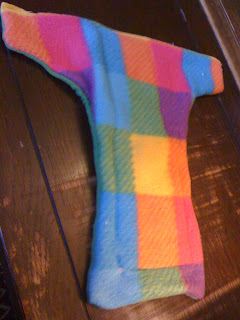 1. I needed them to be much smaller than my motherease one size, so I took a newborn disposable nappy (an eco-friendly free sample), and traced it out on some fleece.
2. I kept experimenting with this until I tapered it enough, had long enough tabs to fasten around the front, etc. This was tricky without an actual baby. Plus I don't know what size she will be when she comes out! So I actually have a few slight variations on this design.
3. I cut out my patterns in fleece and t-shirt or flannel. I decided to use fleece on one side and cotton on the other. Fleece wicks away moisture from baby's skin, so results in a drier nappy for baby. But some babies find synthetic fibres irritating to the skin or just too hot in summer, so my nappies are effectively reversible. I will use nappy pins and nappy nippas (which I don't get on with really) to begin with. If I find a side she likes more I might attach velcro or snaps later. If you are confident in your choice of materials then go ahead and attach velcro or snaps at the end of these directions.

4. I cut out two to three rectangles of terry/towel/flannel depending on thickness. I sewed this down to the centre of the fleece.

5. Then I sewed about 5 inches of elastic (stretching it out as I sewed) on either side of the terry right in the middle where the nappy will wrap around the legs.
 6. Next I sewed the cotton layer to the wrong side of the fleece, almost all of the way around. Then flipped it through to the right sides and sewed the gap.
 7. Wash your nappies without fabric softener three times before use. Fleece is particular become less absorbent when the soap isn't rinsed out enough. So an extra rinse cycle is helpful if you find they leak a bit. I will be trying out my new soap nuts with these nappies and see how they perform. (I used Fairy and a hot wash with my motherease)
Look for my other posts on cloth nappies for more information on using them.
sewingclothnappies
How to Make Cloth Diapers--basically the pattern I used above (adapted)
diaperswappers.com
clothdiapernation.com
clothnappyforum---UK based forum
adventuresindiapering
diaperjungle
diapersewing.com--lots of patterns including for making covers and converting prefolds to fitted
If you are looking for materials and can't find what you like above, I would search using the terms "buy PUL fabric in UK" or "buy diaper materials in USA" or similar. I did get several websites, but chose not to go down that route so cannot endorse any particular company. My mother purchased some PUL from her fabric store to make me some wet bags to store wet nappies in while I am out and about. I will post on this when she gets here in the summer.
I have been searching out small sized nappies, using all in ones, like Bumgenius, or Charlie Banana...but they all seem like such expensive options when I have such a great set of nappies already. And since I have been on Statutory Sick Pay for a few months my budget just dwindled to near nothing.
So I figured making a few nappies would be the best option overall. I do intend to buy small ready made covers from Babykind. I could make them cheaper by buying PUL and binding, etc, but the fit has to be just right and I don't think it will be cheaper if I make loads of mistakes.
The inner, shaped nappies, however are EASY! I used a cheap fleece blanket from IKEA. some old t-shirts, some of my old terries from my son, a few old towels and flannels. This made my set free, because these were all in my house. I even used the elastic from an old, ripped, fitted bedsheet. Though if you are going to purchase anything, elastic is probably a good choice.
There are plenty of suppliers who can provide a number of suitable waterproof, natural, fleecy, colourful etc fabrics which are suitable for making nappies. And many are suitable for making your own all-in-ones, which could save you money. I feel that my sewing skills do not reach this far and that buying nappies is actually a money/time saver. But needs must, so here are my homemade nappies.
I will include links to other websites with great directions. Mine are a bit haphazard as I was experimenting quite a bit. I am very happy with mine and I really hope that they will be suitable when baby arrives.

2. I kept experimenting with this until I tapered it enough, had long enough tabs to fasten around the front, etc. This was tricky without an actual baby. Plus I don't know what size she will be when she comes out! So I actually have a few slight variations on this design.
3. I cut out my patterns in fleece and t-shirt or flannel. I decided to use fleece on one side and cotton on the other. Fleece wicks away moisture from baby's skin, so results in a drier nappy for baby. But some babies find synthetic fibres irritating to the skin or just too hot in summer, so my nappies are effectively reversible. I will use nappy pins and nappy nippas (which I don't get on with really) to begin with. If I find a side she likes more I might attach velcro or snaps later. If you are confident in your choice of materials then go ahead and attach velcro or snaps at the end of these directions.

4. I cut out two to three rectangles of terry/towel/flannel depending on thickness. I sewed this down to the centre of the fleece.

5. Then I sewed about 5 inches of elastic (stretching it out as I sewed) on either side of the terry right in the middle where the nappy will wrap around the legs.


Look for my other posts on cloth nappies for more information on using them.
sewingclothnappies
How to Make Cloth Diapers--basically the pattern I used above (adapted)
diaperswappers.com
clothdiapernation.com
clothnappyforum---UK based forum
adventuresindiapering
diaperjungle
diapersewing.com--lots of patterns including for making covers and converting prefolds to fitted
If you are looking for materials and can't find what you like above, I would search using the terms "buy PUL fabric in UK" or "buy diaper materials in USA" or similar. I did get several websites, but chose not to go down that route so cannot endorse any particular company. My mother purchased some PUL from her fabric store to make me some wet bags to store wet nappies in while I am out and about. I will post on this when she gets here in the summer.
Monday, 7 February 2011
Baby-led Weaning
Gill Rapley draws on her twenty years of experience and research into infant feeding and her work as a health visitor.
This book briefly explains why we have moved from a breastfed diet, to purees, and how we can return to a milk and solid foods diet starting from 6 months of age. The method is suitable for breastfed, formula fed, or mixed feed babies.
I am fascinated by the approach, which skips spoonfeeding and hands solid foods to babies who are old enough to sit up unaided, and able to bring food to their mouths. I found the research and examples quite helpful. Babies who are fed from age four months need purees because they cannot chew yet. Babies develop the ability to chew, and manage food in their mouths from 6 months and above. Babies who are allowed to develop naturally are able to suck on foods and then eventually manage to chew and swallow without choking. This natural progression is actually hampered by feeding babies purees. It is a bit of a messy process, but not much more so than when babies usually start on solids.
Giving babies solid foods to gnaw on is not new and actually practiced in much of the world. In Tanzania, where my Other Half is from, the whole family eats off of a communal plate. Babies are breastfed longer as a rule, but they can join in the family meal when they like. The World Health Organisation actually suggests that babies are breastfed for two years. I did this with my son and never really worried if he had enough solid food because breastmilk is so nutritious and provides most of what babies need.
My son did not have much trouble with spoonfeeding, but I did feel that something wasn't quite right with it. As he got older, I especially was concerned about his getting enough of each nutrient and not too many sweets. This book explains how to work through these dilemmas. This approach advocates a healthy eating plan for the whole family to adopt. And it supports mealtime routines.
This particularly appeals to me right now because our meals have definitely become haphazard over the last few years due to our work schedules. I feel that my son, especially has suffered for this and has become more of a fussy eater of late. I would like to follow some of the nutrition and family routine advice now. Hopefully we will be all ready to adopt the baby led weaning techniques when this baby is 6 months old.
It will be quite a while before I can update on this, since she is currently about 3 months away from being born!
This book briefly explains why we have moved from a breastfed diet, to purees, and how we can return to a milk and solid foods diet starting from 6 months of age. The method is suitable for breastfed, formula fed, or mixed feed babies.
I am fascinated by the approach, which skips spoonfeeding and hands solid foods to babies who are old enough to sit up unaided, and able to bring food to their mouths. I found the research and examples quite helpful. Babies who are fed from age four months need purees because they cannot chew yet. Babies develop the ability to chew, and manage food in their mouths from 6 months and above. Babies who are allowed to develop naturally are able to suck on foods and then eventually manage to chew and swallow without choking. This natural progression is actually hampered by feeding babies purees. It is a bit of a messy process, but not much more so than when babies usually start on solids.
Giving babies solid foods to gnaw on is not new and actually practiced in much of the world. In Tanzania, where my Other Half is from, the whole family eats off of a communal plate. Babies are breastfed longer as a rule, but they can join in the family meal when they like. The World Health Organisation actually suggests that babies are breastfed for two years. I did this with my son and never really worried if he had enough solid food because breastmilk is so nutritious and provides most of what babies need.
My son did not have much trouble with spoonfeeding, but I did feel that something wasn't quite right with it. As he got older, I especially was concerned about his getting enough of each nutrient and not too many sweets. This book explains how to work through these dilemmas. This approach advocates a healthy eating plan for the whole family to adopt. And it supports mealtime routines.
This particularly appeals to me right now because our meals have definitely become haphazard over the last few years due to our work schedules. I feel that my son, especially has suffered for this and has become more of a fussy eater of late. I would like to follow some of the nutrition and family routine advice now. Hopefully we will be all ready to adopt the baby led weaning techniques when this baby is 6 months old.
It will be quite a while before I can update on this, since she is currently about 3 months away from being born!
Thursday, 27 January 2011
Packing for Hospital
I can remember clearly someone warning me to pack my bag early because she had a premature (and thankfully healthy) baby. So I started on my bag when I was 8 months pregnant. But I couldn't put everything in because I was still using my pajamas, big dark underwear, and my toothbrush. Well when my waters broke at 36.5 weeks it was a mad scramble to get everything ready and into the car!
In our ante-natal classes, the midwife told us that we would only need one day's worth of items. I was in hospital for seven days altogether and had to not only ask my partner to bring items, but I had to ask a friend to purchase the car seat, more maternity pads, more underwear and pajamas (since mine were in the wash).
So I am going to do a proper job of it this time.
There isn't much storage space in hospitals and you will likely get moved around a time or two. So you actually need to have two or maybe three bags for your average labour. You will need one bag for labour. The other bag can contain items if you need to stay longer. This second bag and the car seat can be kept in the car. Then send your birth partner out for them when needed. (If you don't have a car, you will still need a car seat if you are using a taxi to get home. But you will also have to lug everything with you).
Labour bag:
Hand held notes and Birth Plan
Phone and charger
Camera
Music--ipod, cds or tapes
Lip balm
Hair scrunchies
Comfy clothes to go home in (or you can wear what you wore to come in)
Snacks for you and birth partners: juice boxes, nuts, cereal bars, biscuits
Entertainment: newspaper, magazines, etc---birth partner might get bored with long waits
Massage balm/oil
socks
slippers/slip on shoes
maternity pads
Nursing bra
Dark, cheap or disposable underwear
Hat
Sleepsuits x 2
Vests x 2
Nappies x 5
(you are advised against using baby lotions, soaps, powders and wipes for the first three months due to baby's delicate skin)
blanket
Optional:
Nightdress---using the hospital gown for labour means less laundry for you when you get home
Makeup---I hear this is important to lots of women....
Flannel/wash cloths
Check with your hospital about:
bottles
formula
nappies
Cotton wool
After-birth Bag
Pack light and ask someone to take away your dirty laundry each day and bring you more items.
Toiletries:
toothbrush and toothpaste
brush
soap, shampoo, conditioner
lip balm
makeup (optional)
deodorant
lotion
antibacterial wipes
witch hazel---to soothe your sore bits
nipple cream
maternity pads
pajamas
or button down nightdress (if breastfeeding)
dark, cheap or disposable underwear
Nursing Bra
Breast pads
socks
slippers/slip on shoes
cardigan or robe
book/magazines
snacks
notebook and pen
comfy clothes
sleepsuits
vests
nappies
hats
In our ante-natal classes, the midwife told us that we would only need one day's worth of items. I was in hospital for seven days altogether and had to not only ask my partner to bring items, but I had to ask a friend to purchase the car seat, more maternity pads, more underwear and pajamas (since mine were in the wash).
So I am going to do a proper job of it this time.
There isn't much storage space in hospitals and you will likely get moved around a time or two. So you actually need to have two or maybe three bags for your average labour. You will need one bag for labour. The other bag can contain items if you need to stay longer. This second bag and the car seat can be kept in the car. Then send your birth partner out for them when needed. (If you don't have a car, you will still need a car seat if you are using a taxi to get home. But you will also have to lug everything with you).
Labour bag:
Hand held notes and Birth Plan
Phone and charger
Camera
Music--ipod, cds or tapes
Lip balm
Hair scrunchies
Comfy clothes to go home in (or you can wear what you wore to come in)
Snacks for you and birth partners: juice boxes, nuts, cereal bars, biscuits
Entertainment: newspaper, magazines, etc---birth partner might get bored with long waits
Massage balm/oil
socks
slippers/slip on shoes
maternity pads
Nursing bra
Dark, cheap or disposable underwear
Hat
Sleepsuits x 2
Vests x 2
Nappies x 5
(you are advised against using baby lotions, soaps, powders and wipes for the first three months due to baby's delicate skin)
blanket
Optional:
Nightdress---using the hospital gown for labour means less laundry for you when you get home
Makeup---I hear this is important to lots of women....
Flannel/wash cloths
Check with your hospital about:
bottles
formula
nappies
Cotton wool
After-birth Bag
Pack light and ask someone to take away your dirty laundry each day and bring you more items.
Toiletries:
toothbrush and toothpaste
brush
soap, shampoo, conditioner
lip balm
makeup (optional)
deodorant
lotion
antibacterial wipes
witch hazel---to soothe your sore bits
nipple cream
maternity pads
pajamas
or button down nightdress (if breastfeeding)
dark, cheap or disposable underwear
Nursing Bra
Breast pads
socks
slippers/slip on shoes
cardigan or robe
book/magazines
snacks
notebook and pen
comfy clothes
sleepsuits
vests
nappies
hats
Searching for PUL
I have been having a look around the Internet for PUL fabric--or similar-- to make some cloth nappy covers, wet bags, and cloth sanitary ware. But most of the sources which come up while doing a search seem to be out of business or out of stock! I guess I was hoping to have some really cute prints as well.
My mother in the USA has offered to do some sewing but the choices and patterns are so limited. Looks like I am back to buying from regular sites. They have a higher quality product than I can make and great designs.
I will have a go at some cloth nappies to fit my newborn though! I will just buy the covers.
My mother in the USA has offered to do some sewing but the choices and patterns are so limited. Looks like I am back to buying from regular sites. They have a higher quality product than I can make and great designs.
I will have a go at some cloth nappies to fit my newborn though! I will just buy the covers.
Tuesday, 25 January 2011
Good thing I am skint...
because I have been looking at the Babykind website researching the new nappy systems out there. A lot has changed over the last four years! I am so confused about what to get to augment my favourite motherease nappies...(if you read my post on cloth nappies you will know I started using cloth nappies when my son was a month old and didn't get on with my first set, so I need to get something to fit my baby for the first couple of months).
And while I was there I was searching around the site because it has been a while. So now I feel I want one of their new wetbags, their changing bag/baby carrier (check it out), fairtrade dolls (can't find mixed race dolls easily for my kids), babybits to make my own wipes solution, natural nappy rash creams and soaps, and cleansing pads. I was planning to buy more of their cloth menstrual pads, but have thankfully decided to make my own.
It is really too bad that we don't have baby showers in the UK!
And while I was there I was searching around the site because it has been a while. So now I feel I want one of their new wetbags, their changing bag/baby carrier (check it out), fairtrade dolls (can't find mixed race dolls easily for my kids), babybits to make my own wipes solution, natural nappy rash creams and soaps, and cleansing pads. I was planning to buy more of their cloth menstrual pads, but have thankfully decided to make my own.
It is really too bad that we don't have baby showers in the UK!
Friday, 31 December 2010
Cloth Nappies
Now cloth nappies are not for everyone. But they have quite a few advantages. They are cheaper, kinder to baby's skin, they don't leak (mine anyway), and they don't fill the landfills. Their disadvantages include lots of washing, they are a bit fiddly when out and about, and they use up water, soap and electricity. They can also be a bit bulky looking compared to today's disposables, but I think they are cute. (Disposables also use electricity to produce, travel and store in the shops, but you aren't paying their electric bill directly).
I knew that I wanted to try cloth, but admit I was really naive going into it. In point of fact I had planned to do some research on the subject, but my son made an early appearance. I hadn't even purchased the car seat yet when my waters broke. (I had to get money from the cash machine in the hospital lobby and phoned my friend to pick it up from Babies-R-Us. I couldn't remember the name of it but gave her a description of it!)
Back to nappies. At the time the only ones I found in the shops were Bambino Mio and Kushies at Babies-R-Us. And I knew you could get muslin squares and terries at Mothercare and Boots. (It did not occur to me that there were hundreds of brands available on the internet. I was just starting out in this business.) I chose Bambino Mio because they were cheaper and they dry more quickly.
Bambino Mio are called pre-folds. They have a rectangle of fabric which is folded and then covered with a waterproof cover. The covers come in several sizes, so they fit the baby really well and are comfortable. Forget the plastic pants of your childhood. These are soft with velcro fastenings. I was very quickly very disappointed with my purchase. Maybe it was my poor folding technique, but I always found baby poo on the covers. While you are meant to be able to use a cover through a few changes, I had to change the cover each time. With only a few covers in the pack, I would run out before the end of the day and had to resort to disposables to get me through until I could wash and dry the nappies. Even drying them on the AGA took half the day or more.
When I complained to a new friend, she told me about Motherease. I quickly went online and ordered some. I also ordered some Wonderoos and some Kushies from e-Bay. I later tried terries and muslins with nappy nippas. I had one Motherease all in one. And I bought one fleece nappy which was a homemade one,off e-Bay.
I have Motherease one-size shaped nappies with covers which come in different sizes. The nappies are terry and mine have a stay-dry lining. The nappies have snaps which adjust so you can fit them on a newborn or a toddler. The covers have several snaps so they adjust around the baby's legs and waist, which makes them last for ages before you need to change sizes. They are quite bulky on a baby I must admit. But they never leak. Ever. And when the baby gets older you can add a snap in liner to absorb more urine. I know people who have used these for four kids or more and so they last forever---although the cute designs on the covers do fade with time.
The Kushies from e-Bay were good, but I was expecting to have the all in ones. Where the ones I won were just shaped inners. I still liked them a lot, and used them with my Motherease covers.
The Wonderoos were a disaster for me. I now know that I might have been washing them all wrong. The other nappies could take a higher temperature wash. I needed it to get rid of odours. But these do not like to be washed above 40C apparently. They also don't like too much soap or fabric conditioner, but no nappies do. It reduces absorbency. So my Wonderoos which were supposed to be this amazing, adjustable, birth to potty pocket nappy leaked all of the time. I will try again with my daughter and see if I can make them work. A pocket nappy is a shaped cover with a lining, and a pocket to place a thick pad in.
I found the Motherease all-in-one was not absorbent enough. The fleece one I purchased both leaked and the velcro came undone. I would find it slipping halfway down my son's trousers. And terries were absorbent enough, but I couldn't find a neat fold I liked and the nippas came undone and scratched my son a time or two. With all of these you will find many people who just love them, but these are my experiences.
For my daughter I would like to try adding some new ones to my collection because I think the Motherease will be too big on a newborn. I have been researching my options and will outline them in a new post.
Using cloth nappies:
(There is a ton of info on the internet about using nappies. And websites often have tips and advice services. One of my favourite websites is Babykind.)
I knew that I wanted to try cloth, but admit I was really naive going into it. In point of fact I had planned to do some research on the subject, but my son made an early appearance. I hadn't even purchased the car seat yet when my waters broke. (I had to get money from the cash machine in the hospital lobby and phoned my friend to pick it up from Babies-R-Us. I couldn't remember the name of it but gave her a description of it!)
Back to nappies. At the time the only ones I found in the shops were Bambino Mio and Kushies at Babies-R-Us. And I knew you could get muslin squares and terries at Mothercare and Boots. (It did not occur to me that there were hundreds of brands available on the internet. I was just starting out in this business.) I chose Bambino Mio because they were cheaper and they dry more quickly.
Bambino Mio are called pre-folds. They have a rectangle of fabric which is folded and then covered with a waterproof cover. The covers come in several sizes, so they fit the baby really well and are comfortable. Forget the plastic pants of your childhood. These are soft with velcro fastenings. I was very quickly very disappointed with my purchase. Maybe it was my poor folding technique, but I always found baby poo on the covers. While you are meant to be able to use a cover through a few changes, I had to change the cover each time. With only a few covers in the pack, I would run out before the end of the day and had to resort to disposables to get me through until I could wash and dry the nappies. Even drying them on the AGA took half the day or more.
When I complained to a new friend, she told me about Motherease. I quickly went online and ordered some. I also ordered some Wonderoos and some Kushies from e-Bay. I later tried terries and muslins with nappy nippas. I had one Motherease all in one. And I bought one fleece nappy which was a homemade one,off e-Bay.
I have Motherease one-size shaped nappies with covers which come in different sizes. The nappies are terry and mine have a stay-dry lining. The nappies have snaps which adjust so you can fit them on a newborn or a toddler. The covers have several snaps so they adjust around the baby's legs and waist, which makes them last for ages before you need to change sizes. They are quite bulky on a baby I must admit. But they never leak. Ever. And when the baby gets older you can add a snap in liner to absorb more urine. I know people who have used these for four kids or more and so they last forever---although the cute designs on the covers do fade with time.
The Kushies from e-Bay were good, but I was expecting to have the all in ones. Where the ones I won were just shaped inners. I still liked them a lot, and used them with my Motherease covers.
The Wonderoos were a disaster for me. I now know that I might have been washing them all wrong. The other nappies could take a higher temperature wash. I needed it to get rid of odours. But these do not like to be washed above 40C apparently. They also don't like too much soap or fabric conditioner, but no nappies do. It reduces absorbency. So my Wonderoos which were supposed to be this amazing, adjustable, birth to potty pocket nappy leaked all of the time. I will try again with my daughter and see if I can make them work. A pocket nappy is a shaped cover with a lining, and a pocket to place a thick pad in.
I found the Motherease all-in-one was not absorbent enough. The fleece one I purchased both leaked and the velcro came undone. I would find it slipping halfway down my son's trousers. And terries were absorbent enough, but I couldn't find a neat fold I liked and the nippas came undone and scratched my son a time or two. With all of these you will find many people who just love them, but these are my experiences.
For my daughter I would like to try adding some new ones to my collection because I think the Motherease will be too big on a newborn. I have been researching my options and will outline them in a new post.
Using cloth nappies:
(There is a ton of info on the internet about using nappies. And websites often have tips and advice services. One of my favourite websites is Babykind.)
- Assemble the nappies when you put them away to make it easier for you, and especially other caregivers to grab one
- Keep a small basin nearby to drop the nappy in when you take it off. Then finish the nappy change, and deal with the basin at your leisure.
- Use flushable liners for ease of dealing with poopy nappies. If they are wet you can wash them about three times to resuse them.
- Do not flush the flushable liners if you have old drains---we made this mistake and it only took a few weeks of doing so to block up 4 metres of drainpipe
- Once you have removed the poo in the toilet or rubbish, then place the nappy in a dry bucket with lid. Plan to wash every 2-3 days.
- Do not buy an expensive nappy bucket from a nappy website! You can get one for under £4 from your local discount store---you know the shops where you see piles of plastic bins and things outside.
- If you are going to use cloth nappies, then use cloth wipes too. You can use warm water, make a solution of wash using water and essential oils, or my preference is to use Baby Bits from Babykind. They are tiny morsels of soap whihc you dissolve in a wipes box. Then place your wipes in the box. They need to be changed every few days.
- Buy the cheapest cloth wipes you can find. But go for ones which have at least one side of terry, the other smooth if possible. The terry really gets the gunk. Or buy and cut up some cheap flannels.
- Use a gentle detergent. If the nappies are really dirty, put them through a pre-wash. If they become really smelly then put them in a really hot wash once in a while. Some people wash wet and poo nappies separately. I haven't tried that. Some people soak smelly nappies in water and essential oil (lavender or tea tree).
- Above all read the washing instructions which come with your nappies. They sometimes have different temperature requirements, etc.
- Shaped nappies last longer and are a good investment if you are going to have more children or sell them used afterwards. All in ones are easy to use, but sometimes wear out after a few years. But you are still likely to save money of you buy two sets, depending on brand. Do you research and read as many reviews as you can.
Tuesday, 28 December 2010
Homemade Baby Food
There are many advantages to making your own baby food. First and foremost you know exactly what your baby is eating. It is much cheaper than food in jars, even on sale. And it tastes so much better. I have no idea why jarred carrots should taste different to mine, but they do.
The disadvantages include the fact that it takes a bit of your time and your baby just might reject the jar of food you try to feed him or her when you are out and about. (My son had a few jarred foods I could rely on for him to gobble down whilst out).
If you cook already, it really isn't that much of a problem to make extra for the baby. To begin with babies start with rice cereal or something similar. But shortly after this you can start single vegetable purees. My doctor told me to start with vegetables. She told me that babies always like fruit, but if you give them apple first, they may prefer the sweetness and reject peas. Most people agree: start with carrots.
You need to gather some equipment:
Ice cube trays
plastic freezer bags
or plastic food containers
mini food processor
saucepan
I find it easier to either fit the cooking into my nightly meal prep or find a bit of time each week to dedicate to the task.
When you have a bunch of carrots on hand, steam or boil them until tender. Pop them in the mini food processor. (I have an attachment for my stick blender). Puree using a bit of the cooking liquid if need be. In a few months you will be blending this leaving a few chunks. Put the puree in the ice cube tray. Let this cool and cover in plastic wrap. Freeze until firm. Pop the carrot cubes out and put them in a plastic bag or box with lid. And back into the freezer.
Repeat this process with spinach, butternut squash, sweet potato, peas, apple, pear, peaches, green beans, and parsnips. Not all at once! Just as and when you can put a pot on the stove.
I have a small drawer in the freezer where I have my baby food cubes. When I want to rustle up a baby dinner I grab two carrot cubes and one spinach. Or one apple, one green bean, and one courgette. Or whatever appeals.
Some baby books recommend trying one food at a time for three days. And some baby books say to never feed a baby the same thing within three days. You can read up on all of that and make your decisions. I know there are a lot of allergies out there. I even know of a child who is allergic to onions and leeks. But most babies are not allergic to peas and carrots. (Fruit allergies are the next big thing I hear).
As your baby grows, you need to make sure your foods are lumpier and before you know it you will simply be mashing what you are cooking for your dinner----before you add salt to the recipe.
This is just a taster. If making your own really appeals then you can get some good books out there. Annabel Karmel's books will become your bibles. But there are loads of baby food books out there with great ideas for weaning, toddler meals, and family meals to appeal to adults too.
The disadvantages include the fact that it takes a bit of your time and your baby just might reject the jar of food you try to feed him or her when you are out and about. (My son had a few jarred foods I could rely on for him to gobble down whilst out).
If you cook already, it really isn't that much of a problem to make extra for the baby. To begin with babies start with rice cereal or something similar. But shortly after this you can start single vegetable purees. My doctor told me to start with vegetables. She told me that babies always like fruit, but if you give them apple first, they may prefer the sweetness and reject peas. Most people agree: start with carrots.
You need to gather some equipment:
Ice cube trays
plastic freezer bags
or plastic food containers
mini food processor
saucepan
I find it easier to either fit the cooking into my nightly meal prep or find a bit of time each week to dedicate to the task.
When you have a bunch of carrots on hand, steam or boil them until tender. Pop them in the mini food processor. (I have an attachment for my stick blender). Puree using a bit of the cooking liquid if need be. In a few months you will be blending this leaving a few chunks. Put the puree in the ice cube tray. Let this cool and cover in plastic wrap. Freeze until firm. Pop the carrot cubes out and put them in a plastic bag or box with lid. And back into the freezer.
Repeat this process with spinach, butternut squash, sweet potato, peas, apple, pear, peaches, green beans, and parsnips. Not all at once! Just as and when you can put a pot on the stove.
I have a small drawer in the freezer where I have my baby food cubes. When I want to rustle up a baby dinner I grab two carrot cubes and one spinach. Or one apple, one green bean, and one courgette. Or whatever appeals.
Some baby books recommend trying one food at a time for three days. And some baby books say to never feed a baby the same thing within three days. You can read up on all of that and make your decisions. I know there are a lot of allergies out there. I even know of a child who is allergic to onions and leeks. But most babies are not allergic to peas and carrots. (Fruit allergies are the next big thing I hear).
As your baby grows, you need to make sure your foods are lumpier and before you know it you will simply be mashing what you are cooking for your dinner----before you add salt to the recipe.
This is just a taster. If making your own really appeals then you can get some good books out there. Annabel Karmel's books will become your bibles. But there are loads of baby food books out there with great ideas for weaning, toddler meals, and family meals to appeal to adults too.
Breastfeeding
I love breastfeeding! I think that it is utterly amazing. Next to pregnancy and childbirth it must be the most miraculous thing that we are actually created to feed babies! What engineering. I know there are lots of folks out there who can't or choose not to for many reasons. In this life we have to do what we have to do. And that is okay by me. But I am feel very fortunate that I was able to breastfeed my son and I hope to be able to do the same with my daughter.
Although I was keen to breastfeed my son, and attended the lecture on it during my antenatal classes, I was surprised to find that it was quite difficult at first. Firstly because my son was in the Special Care Baby Unit (SCBU) for three days, and the nursery nurses kept feeding him formula through a tube in his nose despite the fact that I was meant to try feeding him first. Then I found the whole process quite painful. Both the latching on bit and the "letdown." The breastfeeding video we saw in class told us that if it was painful then we were doing it wrong!! So I panicked a little until a proper lactation nurse came by and told me that it was nonsense. So after a few more days we started to get the hang of it and were allowed home.
At home the midwife came and told me that it takes six weeks to become an expert. This helped me keep going because it was still quite painful. The nipple creams helped with the sore nipples, but this letdown pain was hard to bear at times. But sure enough within weeks we were flying.
I was feeding "on demand," and my son was demanding! Sometimes I think I was feeding every hour. I was producing tons of milk and leaking everywhere! I slept with several layers of towels under me at night. But that phase passed as well. I thought I would continue for a year if I could. I am lactose intolerant, so I worried whether my son could have milk. And I really didn't want to mess around with formula if I didn't have to. Traipsing around in the middle of the night making and heating bottles is not my idea of fun!
When I returned to work (when my son was a year old) I did indeed find I was able to continue breastfeeding morning and evening. And he was eating food, yoghurt and sometimes milk in between. I intended to stop feeding about then, but soon left that job and found myself home with him again. I breastfed him until he was just over two years old, which is recommended by the World Health Organisation.
The way I got him to stop was by enlisting his father's help. My son would come in to my bed each morning for a feed. Then we would head downstairs for a banana, then cereal and Cebeebies. So for one week I asked for help. Daddy was to bring him down, feed him breakfast and otherwise distract him. Worked like a charm. The after work feed ended about the same time by simply telling him that I didn't have any milk anymore. He did ask to check. He wanted to see there wasn't any milk, but believed me when I was persistent.
I am not sure that I will feed my daughter for so long. I really hadn't intended to go so long with my son. I will be returning to work after about six months maternity leave this time around. So I am not sure how I will manage that, pumping, etc. I will have to consider this when the time comes. I know that I will not be able to pump at work. (Although it is law in this country that employees are allowed breaks and the space to pump while at work). There is just no private place in which to do it. Even the toilets would not be private enough and they are hardly appropriate places anyway. So we will see.
Although I was keen to breastfeed my son, and attended the lecture on it during my antenatal classes, I was surprised to find that it was quite difficult at first. Firstly because my son was in the Special Care Baby Unit (SCBU) for three days, and the nursery nurses kept feeding him formula through a tube in his nose despite the fact that I was meant to try feeding him first. Then I found the whole process quite painful. Both the latching on bit and the "letdown." The breastfeeding video we saw in class told us that if it was painful then we were doing it wrong!! So I panicked a little until a proper lactation nurse came by and told me that it was nonsense. So after a few more days we started to get the hang of it and were allowed home.
At home the midwife came and told me that it takes six weeks to become an expert. This helped me keep going because it was still quite painful. The nipple creams helped with the sore nipples, but this letdown pain was hard to bear at times. But sure enough within weeks we were flying.
I was feeding "on demand," and my son was demanding! Sometimes I think I was feeding every hour. I was producing tons of milk and leaking everywhere! I slept with several layers of towels under me at night. But that phase passed as well. I thought I would continue for a year if I could. I am lactose intolerant, so I worried whether my son could have milk. And I really didn't want to mess around with formula if I didn't have to. Traipsing around in the middle of the night making and heating bottles is not my idea of fun!
When I returned to work (when my son was a year old) I did indeed find I was able to continue breastfeeding morning and evening. And he was eating food, yoghurt and sometimes milk in between. I intended to stop feeding about then, but soon left that job and found myself home with him again. I breastfed him until he was just over two years old, which is recommended by the World Health Organisation.
The way I got him to stop was by enlisting his father's help. My son would come in to my bed each morning for a feed. Then we would head downstairs for a banana, then cereal and Cebeebies. So for one week I asked for help. Daddy was to bring him down, feed him breakfast and otherwise distract him. Worked like a charm. The after work feed ended about the same time by simply telling him that I didn't have any milk anymore. He did ask to check. He wanted to see there wasn't any milk, but believed me when I was persistent.
I am not sure that I will feed my daughter for so long. I really hadn't intended to go so long with my son. I will be returning to work after about six months maternity leave this time around. So I am not sure how I will manage that, pumping, etc. I will have to consider this when the time comes. I know that I will not be able to pump at work. (Although it is law in this country that employees are allowed breaks and the space to pump while at work). There is just no private place in which to do it. Even the toilets would not be private enough and they are hardly appropriate places anyway. So we will see.
Sick Babies
Chances are that your baby is gong to come down with a high fever after the doctors office is closed. You will then stay up half the night trying to get your baby to swallow some vile children's paracetamol. At least half of it will end up down their sleepsuit. Then you get to worry about how much ended up on the jumper and how much in the baby. If you give the baby more, you could overdose the poor child. If you don't give enough untold things will happen because you haven't reduced the fever.
In the morning, when you have gotten through all of that, the two of you head to the doctor. You are all bleary eyed and worried. Your baby is bright as a button. The doctor will tell you to keep giving the meds (and you still have no clue how) until the fever is gone and that your baby is fine. For a crazy moment you wish your baby would cry or something so you don't seem like a first class idiot.
In truth, the doctors will always say that they are always happy to see you when you are worried about your child. And even though they may see plenty of cases where they simply say keep doing what you are doing, they also get cases of more severe problems. With some illnesses like meningitis and urine infections you really need a doctor to diagnose and provide immediate medical care. In fact if you suspect meningitis you need to go to a hospital quite urgently. It is well worth having a family medical book. And keep the phone numbers for NHS Direct and out of hours medical care handy. I phone them a few times a year at least.
In the first year of my son's life he went through at least a bottle of children's meds, albeit some of it just landed down his pajamas. He had various fevers and teething pains, usually while his father was at work or out of town, etc!! It took another three years to get through the next bottle. Partly because as he got older he was better able to refuse the stuff!! Eventually they learn to tell you what is hurting them--which isn't as reassuring as it sounds! You still have no idea what to do if they have a pain in their side....or their jaw...or any of the other weird and wonderful things they come up with. But it all does get easier with experience.
In the morning, when you have gotten through all of that, the two of you head to the doctor. You are all bleary eyed and worried. Your baby is bright as a button. The doctor will tell you to keep giving the meds (and you still have no clue how) until the fever is gone and that your baby is fine. For a crazy moment you wish your baby would cry or something so you don't seem like a first class idiot.
In truth, the doctors will always say that they are always happy to see you when you are worried about your child. And even though they may see plenty of cases where they simply say keep doing what you are doing, they also get cases of more severe problems. With some illnesses like meningitis and urine infections you really need a doctor to diagnose and provide immediate medical care. In fact if you suspect meningitis you need to go to a hospital quite urgently. It is well worth having a family medical book. And keep the phone numbers for NHS Direct and out of hours medical care handy. I phone them a few times a year at least.
In the first year of my son's life he went through at least a bottle of children's meds, albeit some of it just landed down his pajamas. He had various fevers and teething pains, usually while his father was at work or out of town, etc!! It took another three years to get through the next bottle. Partly because as he got older he was better able to refuse the stuff!! Eventually they learn to tell you what is hurting them--which isn't as reassuring as it sounds! You still have no idea what to do if they have a pain in their side....or their jaw...or any of the other weird and wonderful things they come up with. But it all does get easier with experience.
Subscribe to:
Posts (Atom)